Tally — The Front-Door for Structured Input
How Tally replaces glue code by capturing structured, relational data from day one — and how a single form submission triggers a full tenant provisioning flow through Attio and Kaiten.


April 16, 2026 • 5 min read • Alexandre Bergère
Every week, we break down one tool from the stack that powers Kaiten — what it does, why we picked it, and how it fits into a unified SaaS architecture.
Prefer the printable version? Download the PDF.
What is Tally?
Tally is a minimalist, Notion-like form builder that allows SaaS founders to create complex data capture flows in seconds. It functions as the primary "Front-End" for Kaiten, ensuring that every user interaction — from beta requests to onboarding — is captured as structured, relational data from Day-1.
Most founders think of forms as a commodity: pick Typeform or Google Forms, embed it, move on. That's fine if you're collecting newsletter signups. It's not fine if the data in that form is the first step in provisioning a customer.
Why Tally?
Three capabilities make Tally the right choice for a technical founder who cares about data flow.
Instant Iteration
Deploy production-ready forms for lead generation or surveys with zero engineering overhead. The Notion-like editor means you can go from "I need a form" to "the form is live" in minutes, not hours. And when your onboarding flow changes (and it will, repeatedly, in the first year), you update the form without touching any code.
Relational Accuracy
This is the underrated one. Tally lets you use native logic to translate form fields into structured "Company + Person" relationships. A single form submission can capture both the organization and the individual — with the right fields mapped to the right objects. This matters because your downstream systems (CRM, provisioning, billing) think in terms of Companies and People, not flat rows of form data.
Webhook-First DNA
Native support for outbound events makes Tally the perfect "trigger" for your automation stack. Every form submission fires a webhook with a clean JSON payload. No polling. No Zapier. No "check for new responses every 5 minutes." The data moves the instant the user clicks Submit.
The Front-Door: Structured Input
Capturing data is simple; capturing actionable data is the challenge. By using Tally as your primary input layer, you force data quality at the source. This prevents Glue Code debt by ensuring every lead enters your ecosystem with a valid structure before it ever reaches your infrastructure.
Here's the key insight: every form field you design is a schema decision. If you ask for "Company name" and "Email" in the same flat form, you'll spend time later splitting them into separate objects in your CRM. If you design the form with the Company/Person split from the start, the data arrives structured.
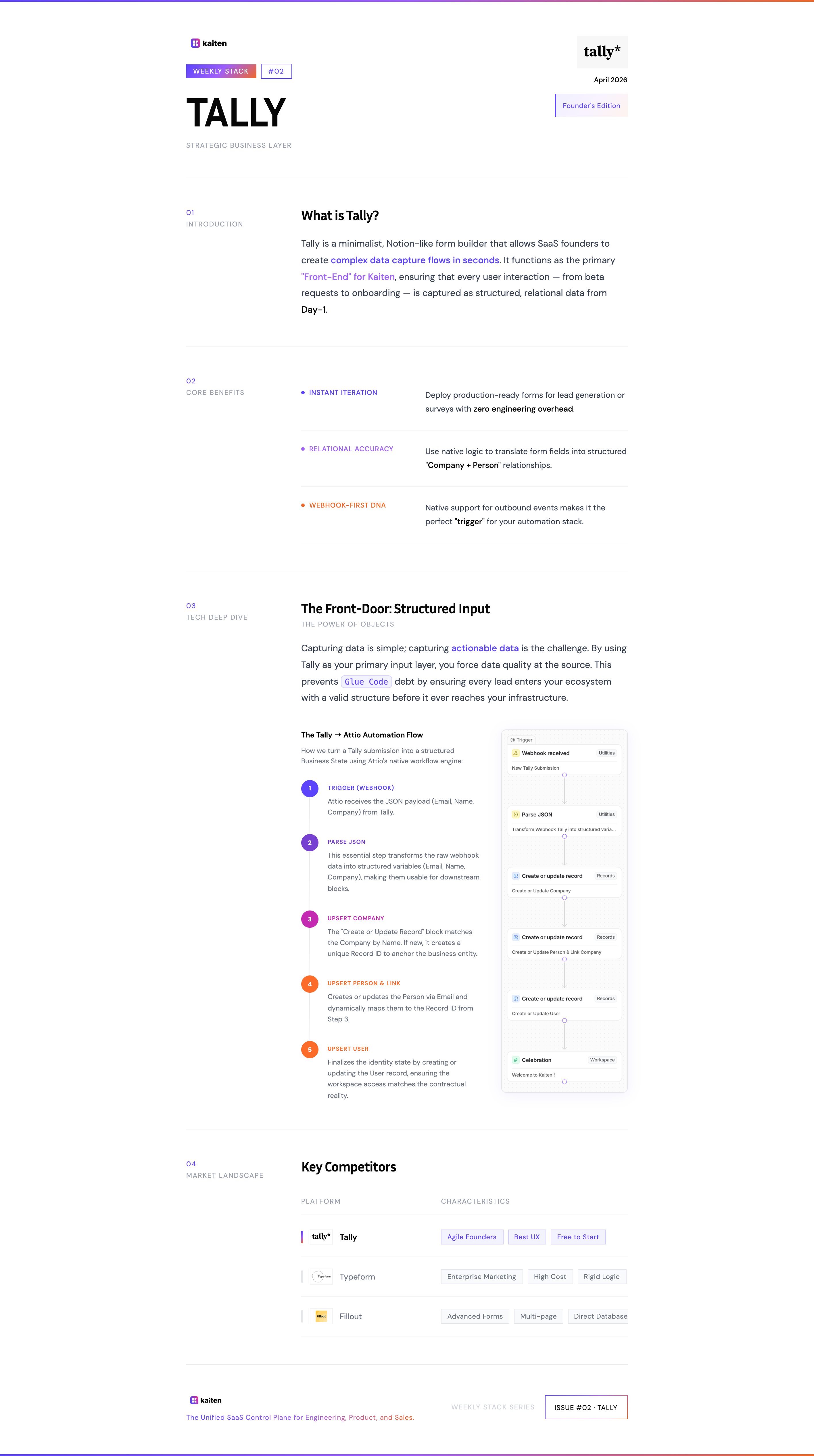
The Tally → Attio Automation Flow
This is where things get interesting. Here's how we turn a Tally submission into a structured Business State using Attio's native workflow engine.
Step 1 — Trigger (Webhook). Attio receives the JSON payload (Email, Name, Company) from Tally. This is a native Attio automation — no third-party tool in between.
Step 2 — Parse JSON. This essential step transforms the raw webhook data into structured variables (Email, Name, Company), making them usable for downstream blocks.
Step 3 — Upsert Company. The "Create or Update Record" block matches the Company by Name. If new, it creates a unique Record ID to anchor the business entity. If the company already exists (a second person from the same org signs up), it links to the existing record.
Step 4 — Upsert Person & Link. Creates or updates the Person via Email and dynamically maps them to the Record ID from Step 3. The Person is now linked to their Company in the CRM.
Step 5 — Upsert User. Finalizes the identity state by creating or updating the User record, ensuring the workspace access matches the contractual reality.
The entire flow runs in seconds, with no human intervention. A form submission on your landing page at 2 AM becomes a fully structured Company + Person + User record in Attio by the time the user sees the "Thank you" page.
And from there? Attio's record.created webhook fires, and Kaiten picks it up to provision the tenant — as described in Weekly Stack #01 (Attio). The chain is: Tally → Attio → Kaiten. Three systems, one unbroken data flow, zero manual steps.
Market Landscape
How does Tally compare to the alternatives?
Tally — Agile Founders, Best UX, Free to Start. Notion-like simplicity, webhook-native, free tier that actually works. The right choice if you want forms that feed automation, not just collect data.
Typeform — Enterprise Marketing, High Cost, Rigid Logic. Beautiful forms, but priced for marketing teams with budget. The conditional logic is powerful but hard to maintain at scale. Webhook support exists but it's not the primary design philosophy.
Fillout — Advanced Forms, Multi-page, Direct Database. Strong option if you need direct database connections (Airtable, Notion, Supabase). More technically powerful than Tally on pure form logic, but heavier to set up. Worth considering if your forms need complex multi-page flows.
Why This Matters for Your Stack
The common pattern in early SaaS is: form tool → Zapier → CRM → manual provisioning. Every arrow in that chain is a failure point. Zapier has rate limits, costs money, and breaks silently. Manual provisioning means someone has to be awake.
Tally removes the first Zapier arrow (webhook-native). Attio's workflow engine removes the second (native automation). Kaiten removes the third (automated provisioning). What you're left with is a pipeline where the user fills a form and the tenant exists — no human required.
That's not about being clever with automation. It's about building the plumbing right from the start so you don't spend your first year retrofitting it.
This is Weekly Stack #02. Every week, we break down one tool from the Kaiten stack. Previously: Attio — the CRM that thinks like a database.
From form submission to provisioned tenant — zero manual steps
Tally captures the data. Attio structures it. Kaiten provisions the infrastructure. One flow, no glue code.
You might also like
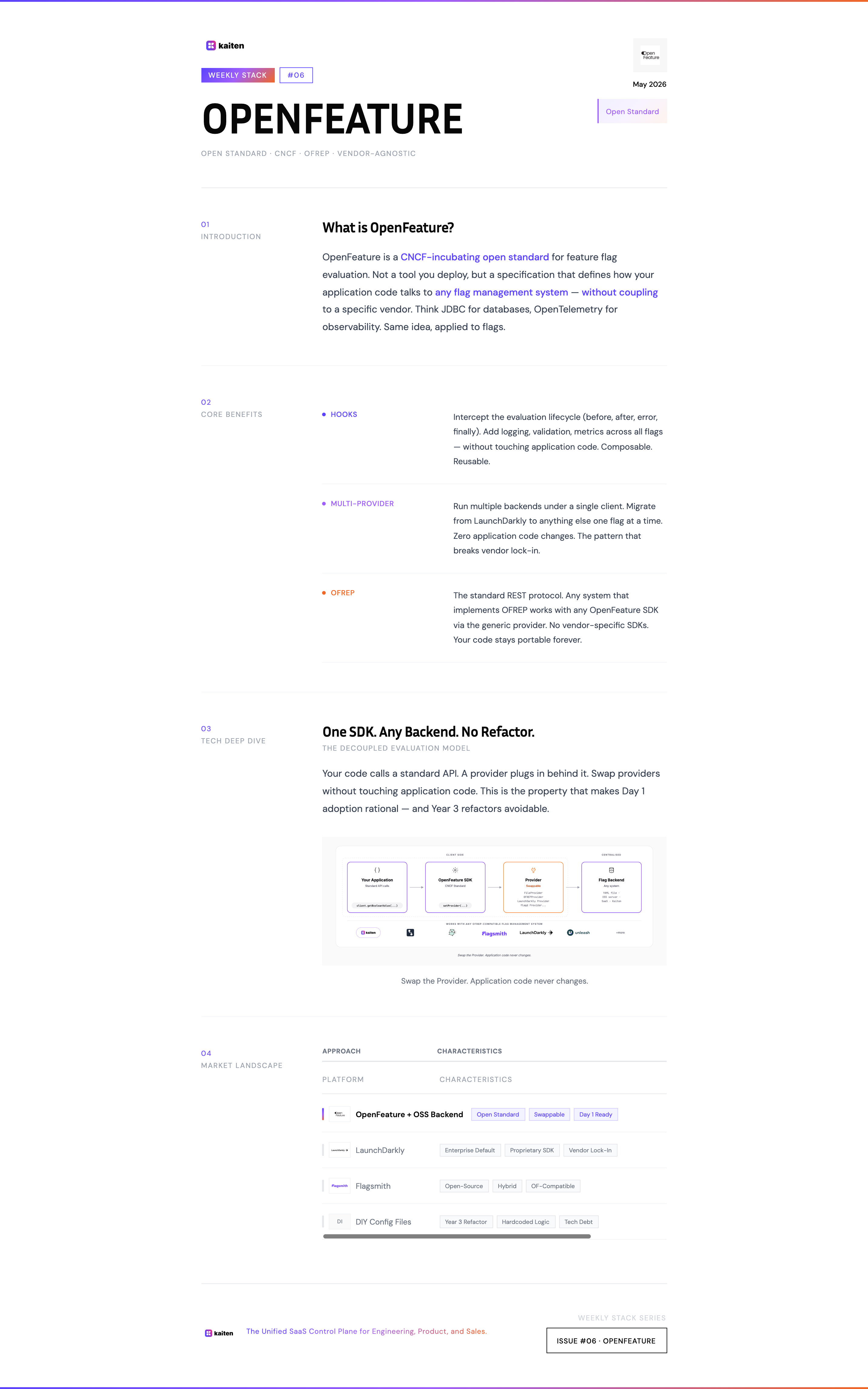
OpenFeature — Stop Building Flag Systems in Year 3. Start on Day 1.
Most teams hardcode their packaging logic for 2-3 years, then spend a quarter refactoring when engineering hits 15 people. OpenFeature is the discipline that makes that refactor unnecessary — adopted on Day 1, it costs nothing. Adopted on Year 3, it's a tax.
May 14, 2026 • 13 min read
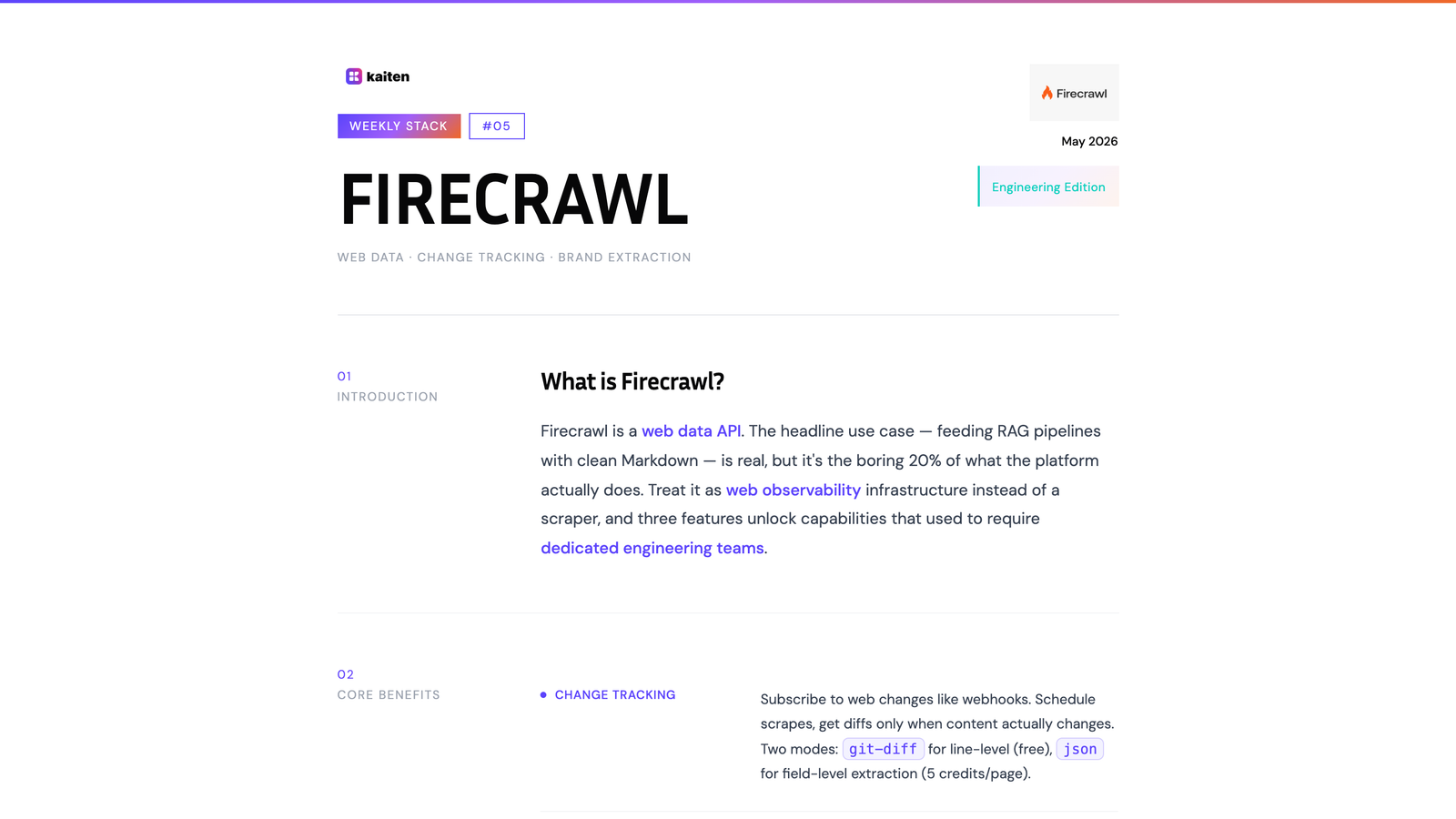
Firecrawl — Stop Treating It Like a Scraper. It's a Web Observability Platform.
Most teams use Firecrawl for one thing: feeding their RAG pipeline. They miss the three features that turn it into something fundamentally different — a continuous observability layer for the public web.
May 7, 2026 • 10 min read
Neon — Postgres Rebuilt for the Cloud (And Why Our Free Tier Burns Out)
Why we use Neon for staging and production at Kaiten — and the brutal honesty about why our free tier burns out before the end of the month thanks to Debezium.
April 30, 2026 • 7 min read