Web Summit 2026: how we prepared, and what a storm changed
We went to Lisbon with three small pages built with Claude: a ranked list of 10,500 attendees, a shared agenda and a lead form for the phone. Then Storm Charles took our booth day. What worked, and what comes next.


November 16, 2026 • 12 min read • Alexandre Bergère
Kaiten went to Web Summit 2026 in Lisbon as an ALPHA startup, with one booth day, two products to show and a short list of people to meet. A storm took the booth day. We still came back with 27 leads captured at the booth and around it, and 92 new connections in the Web Summit app.
This is how we prepared, mostly with small shared pages we built with Claude, and what happened once we were there. The pages are the part worth copying. The screenshots use made-up people and companies: the real pages hold contact details.

Two goals, one brief
We wrote the brief a week before, in a shared document, around two goals:
- Find B2B SaaS teams for Kaiten, AI-native and regulated companies first.
- Recruit beta testers for Nagare, our competitive-intelligence product, among product managers and product marketers.
Every tool below serves one of these goals. None of them is a product we bought. Each is a page we built with Claude over a few sessions, published as a Claude artifact, with a small shared database so the whole team sees the same data. A page like this costs little to build and nothing to throw away after the event.
Targets: from 10,500 attendees to 30 people to meet
Web Summit gives each attendee a directory of the people and companies there. We scraped it with a small script running in the browser, merged it with a second attendee list, and ended up with about 10,500 people to analyse: title, company, country and, for exhibitors, the company's pitch. Nobody reads 10,500 profiles, so the job was to rank them.
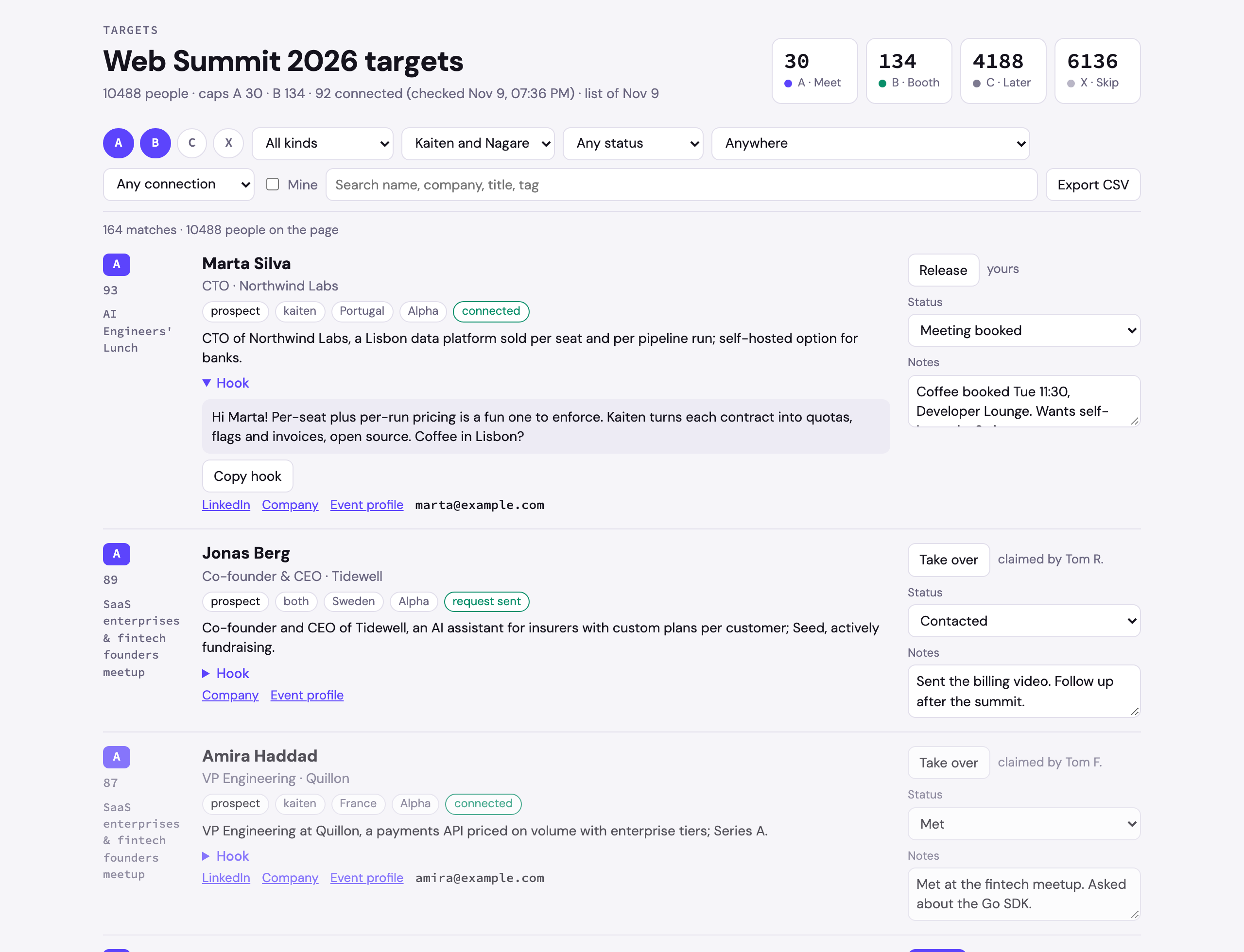
Each person gets four marks from 0 to 5: fit (does the company look like a Kaiten or Nagare customer or partner), role (can this person decide or influence), signals (fundraising, self-hosted, usage-based pricing, regulated) and reach (can we actually meet them). The score weights them 35, 30, 20 and 15 out of 100. A score of 70 or more is tier A, "meet", capped at 30 people. From 55 it is tier B, "booth", capped at 134. The rest is C, "later", or X, "skip". Two rules keep the top of the list balanced: a few tier-A slots are reserved, five of them for Nagare testers, and each company gets at most one tier-A slot.
We scored in two passes. Simple rules ranked everyone at no cost. Then Claude reviewed 670 profiles, reading each one and writing the marks, a one-line reason and the event where we were most likely to cross paths. The review cost 1,300 to 3,700 tokens a person, whatever the model. It only paid off on profiles with a company pitch: on a bare name and title, the model mostly answered "company to verify".
For the 152 people we wanted to reach in tiers A and B, we wrote one hook each, no template: their first name, one specific thing about their company, one plain line about Kaiten or Nagare, and a light invitation (a coffee, a pastel de nata, the LEGO draw). Each hook went out as the note of a connection request in the Web Summit app. By Monday evening, the opening night, 45 of them had accepted.
The page shows all of it: the tier tiles, filters by kind, product, side event and connection status, the hook with a Copy button, and on the right, who on the team has claimed the person, the status and notes. When someone accepts, the page shows it, with the contact details they chose to share.
The shared agenda: four schedules, one page
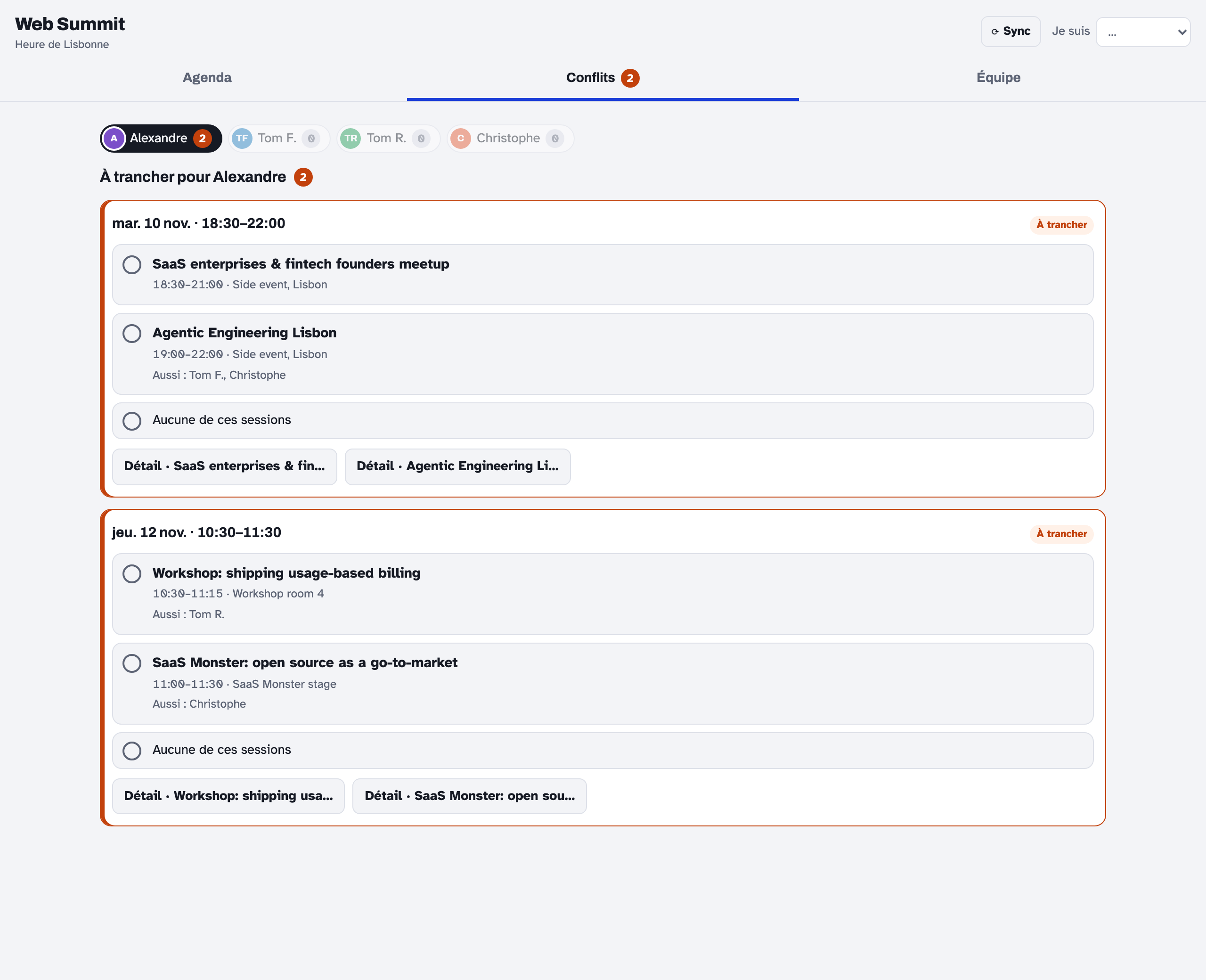
Each of us built a schedule in the Web Summit app, and each schedule lived in its own phone. The agenda page brings them together. Everyone downloads their schedule as an .ics file from the app and imports it, or pastes it. The page then shows each day in Lisbon time, one column per person, so you see at a glance who is at which talk or side event, and where the team is spread thin or doubled up.
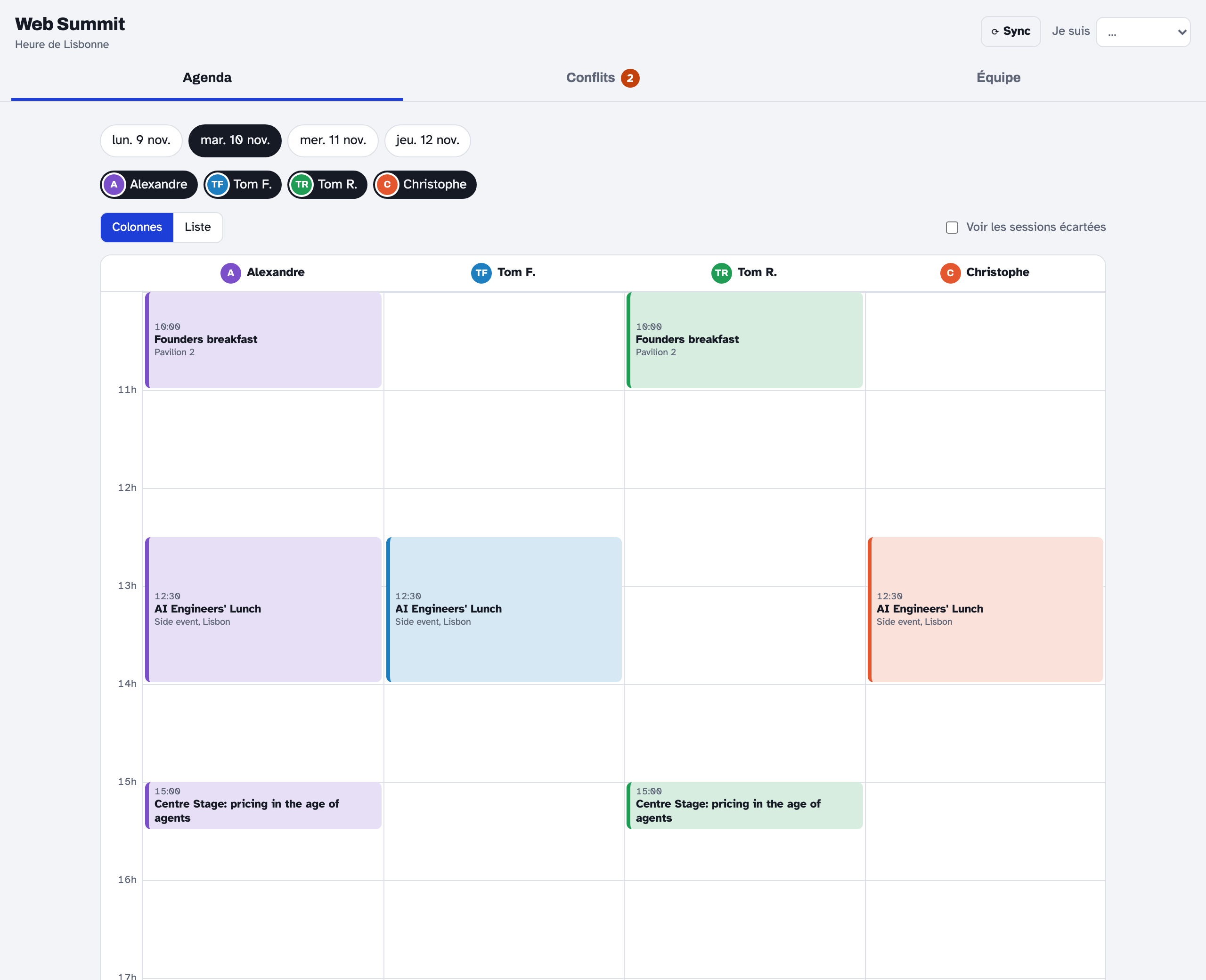
The second tab lists conflicts: two sessions of one person that overlap. Each conflict waits for a decision, one of the sessions or none, and says which teammates already go to each. Set-aside sessions disappear from the columns but stay one tick away. A teammate built this page, in French, for the four of us.
Booth Leads: a lead in under a minute, on a phone
At a booth, a conversation ends with a handshake and, too often, nothing written down. Booth Leads is the page we opened on our phones after each conversation. It asks for as little typing as possible.
The badge. You photograph the person's badge, and the page fills in their first name, last name and company. The reading happens on the phone, with an open-source OCR engine, Tesseract.js: no AI model and no network call to read it. The photo is then stored with the lead, so the team sees it. When the OCR misses, a Fill from photos button can ask Claude to read the photos instead. The badge's QR code only carries an attendee id, not a name, so the page reads the printed label. It finds the white label, straightens it using the angle of the QR code, and masks the QR code before reading. Our test badge reads in about a second on a laptop.
LinkedIn. Most people do not know their profile URL. The page tells you how to ask: open LinkedIn, tap the QR icon in the search bar, then My code. You photograph that code and the profile link fills in.
Context and notes. Who they are (prospect, partner, press, talent), which product they care about, how warm the conversation was, then free notes: what they do, what they need, what we promised.
Bad Wi-Fi. A lead is saved on the phone first, then sent to the shared list when the network comes back, so nothing typed is lost. The page lists everyone's leads by day, with search, filters and a CSV export.
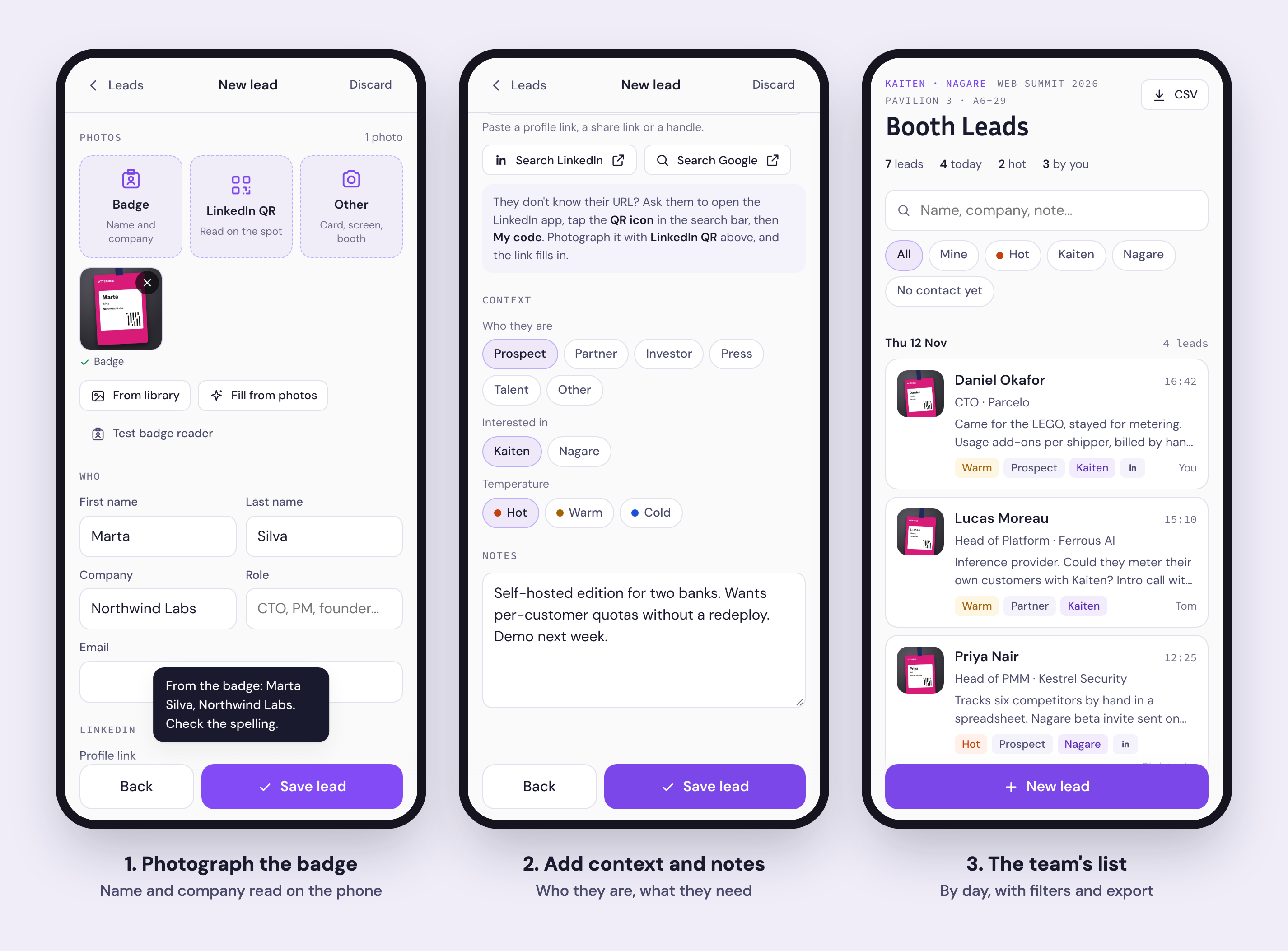
Two things only showed up on real phones. In the Claude app on Android, the photo buttons did not open the camera, so the page now tells Android users to open it in Chrome. Under the violet stage lights, the white label looked violet, and finding it failed; the page now corrects the white balance before looking for it.
The rest of the kit
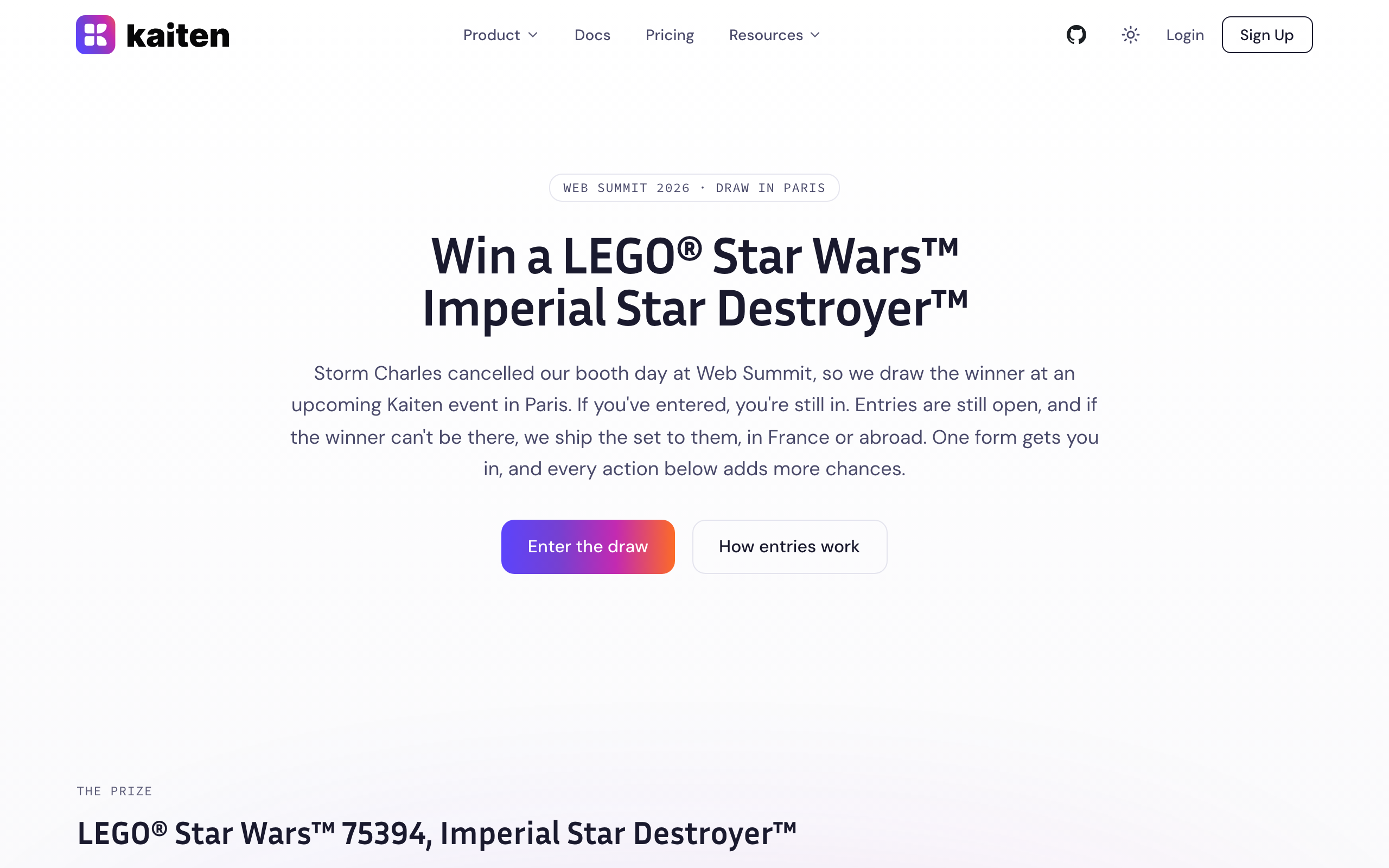
A draw that gives people a reason to stop. We raffled a LEGO® Star Wars™ Imperial Star Destroyer™, with a page on our site, kaiten.sh/websummit. One form gets you in. Each extra action adds entries, up to 17: starring our GitHub repositories, following Kaiten or Nagare on LinkedIn, a post that tags us. The rules sit on the page, and the page offers example posts to copy.
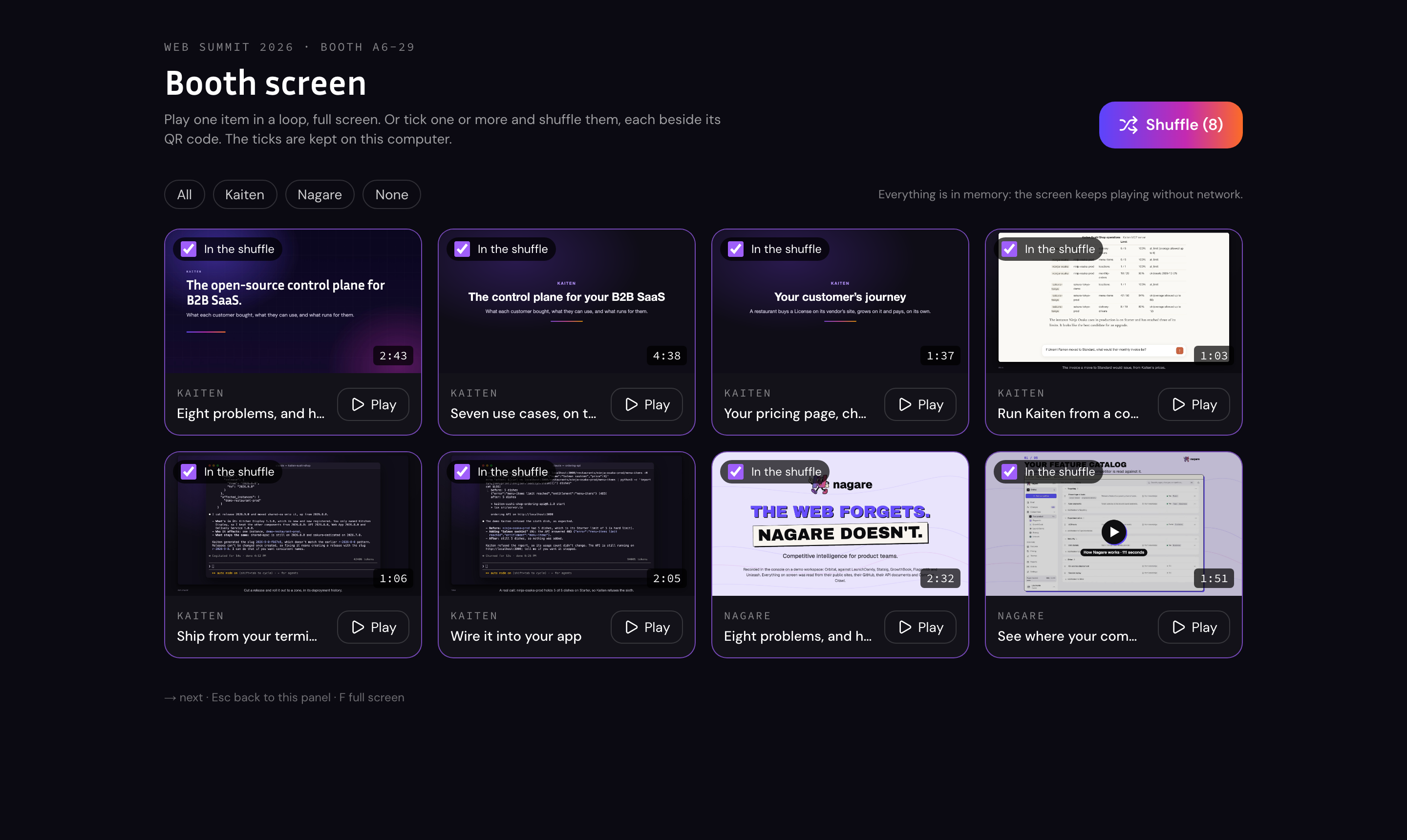
A booth screen that survives the Wi-Fi. The screens on the counter played kaiten.sh/websummit/screen, a kiosk page with our product videos. It opens on a panel: play one video on its own, full screen, or tick several and shuffle them. It loads every video into memory when it opens, so it keeps playing if the network drops, and it keeps the screen awake. In shuffle mode, each video plays beside a QR code to the right site, tagged so we can tell a scan of the screen from a scan of a card.
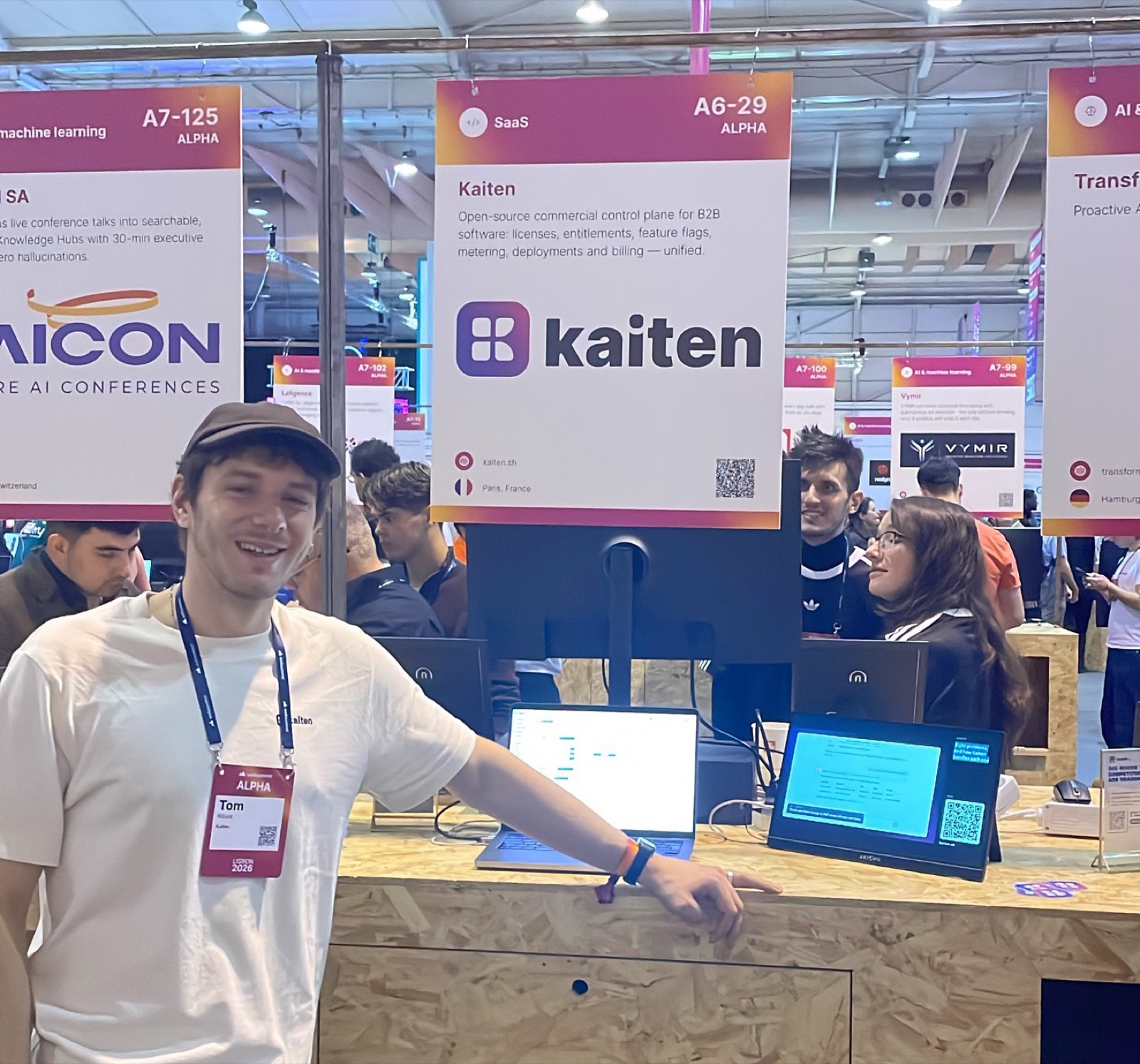
Cards on the counter. Three small framed cards, one each for Kaiten, Nagare and the draw, each with its own QR code.
How it went
Monday and Tuesday went to plan: the opening night, talks, side events and the floor. One line from a Venture Summit talk on how open-source companies make money in the age of AI stayed with us: developers adopt, executives buy. Tuesday alone brought 13 leads, before we had a booth at all.
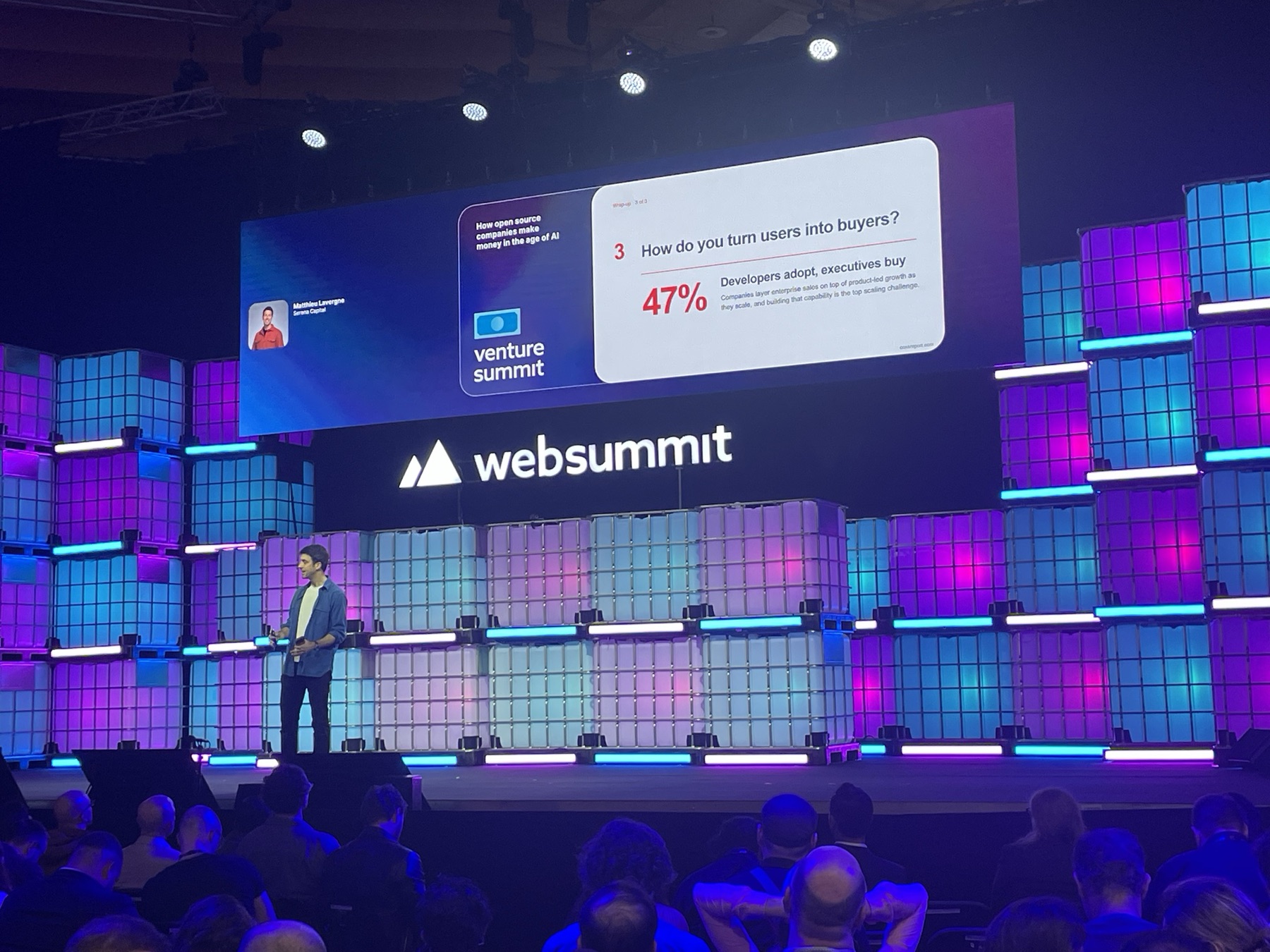
Kaiten also got its 40 words on a Web Summit stage, in the 40 Words series. We filmed it from the audience.
Wednesday was our booth day, and Web Summit called it off. On the Portuguese government's advice, the event closed for the day because of Storm Charles. Disappointing, and the right call. We used the day to finish our next release. It ships on 16 November, with the AI Control Plane in beta.
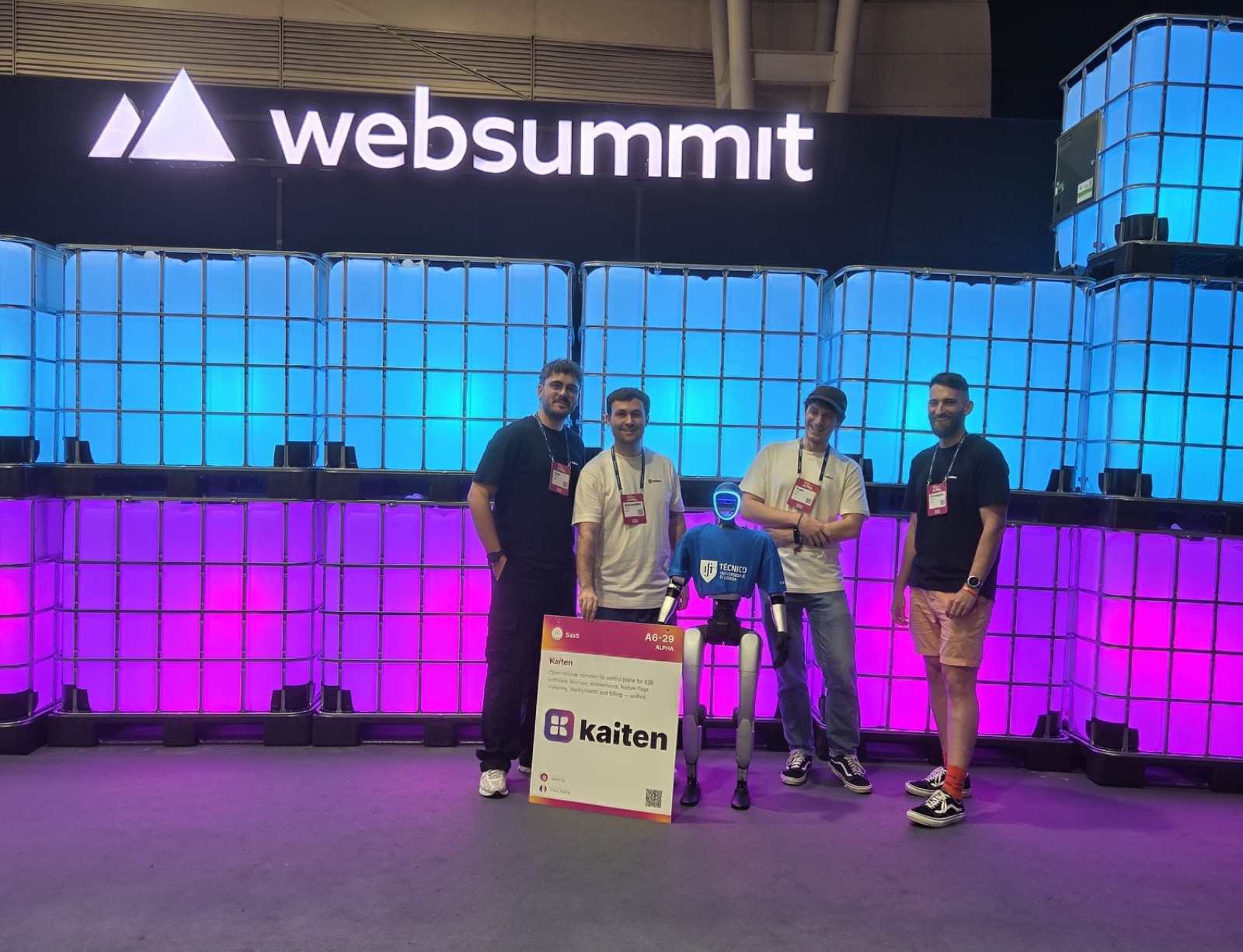
Thursday, the last day, a fellow founder who could not attend it, Carlo, gave us their spot: A7-124, Pavilion 4. Our printed sign still said A6-29, so it hung there between two other startups' signs. Kevin, our fourth co-founder, could not come to Lisbon, so a plush Kevin came instead. It hides in our team photo. Thursday brought 14 more leads. We moved the LEGO draw to an upcoming Kaiten event in Paris: everyone who entered stays in, and we ship the set if the winner lives abroad.
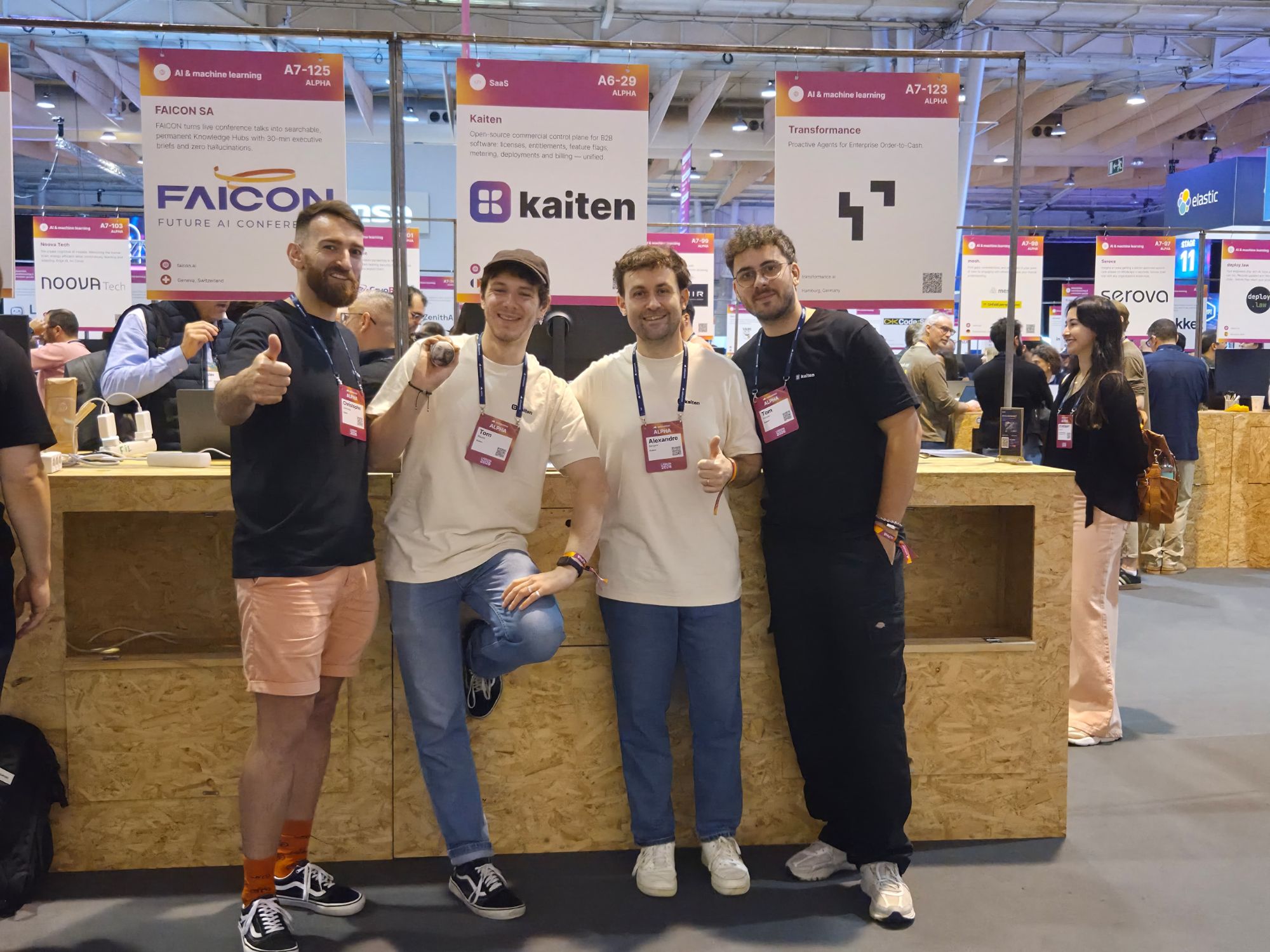
In numbers: 27 leads captured by three of us, 26 of them with notes and 26 with photos, 22 of those of a badge. And 92 people connected with us in the Web Summit app.
After the summit: the pages keep working
An event's value shows in the weeks after it, and both pages were built for that part too.
Booth Leads is the follow-up list. Each lead carries the notes written a minute after the conversation, the badge photo that says who it was, and what we promised. Filters bring up the hot leads, those for Kaiten or for Nagare, and those with no email or LinkedIn yet, the ones to track down first. A CSV export takes the list anywhere else.
Targets is the second list: the people we never met in person but who accepted a request. Their status moves from contacted to meeting booked to met, with notes. Claiming a person matters here: two of us should not write to the same founder. The page shows who accepted and the contact details they shared, and exports to CSV as well.
Both hold personal data, so they have an end date: we delete the working lists 30 days after the follow-ups.
We wrote most of this on the way home. Twenty-four hours on a bus from Lisbon leave time for a quick debrief while it is fresh, and for deciding what comes next.
See Kaiten in under three minutes
Eight problems of a B2B SaaS, from the catalogue to the invoice, each handled in the product on the Kaiten Sushi Shop demo. It is the video that played on our booth screen.
You might also like
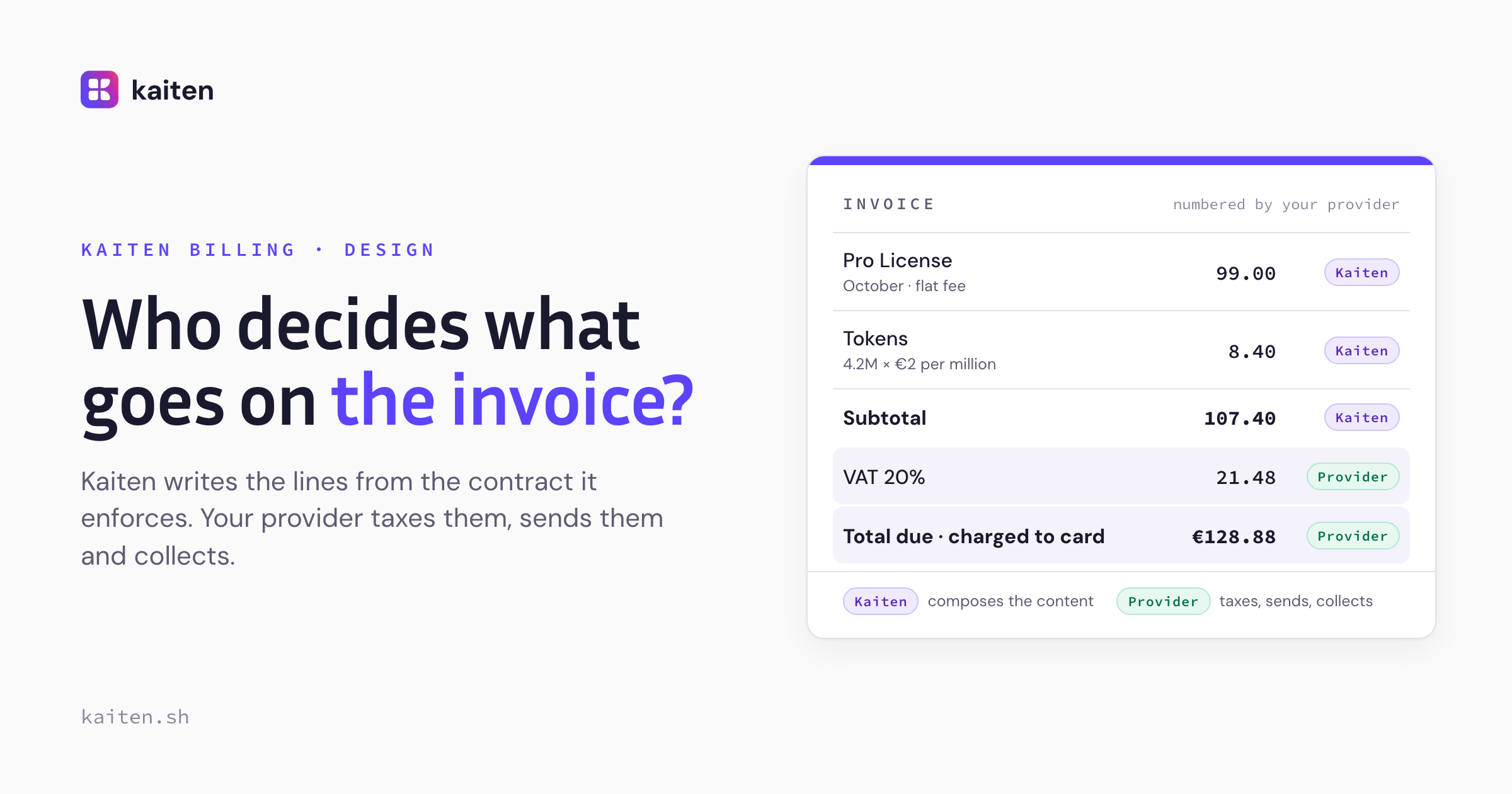
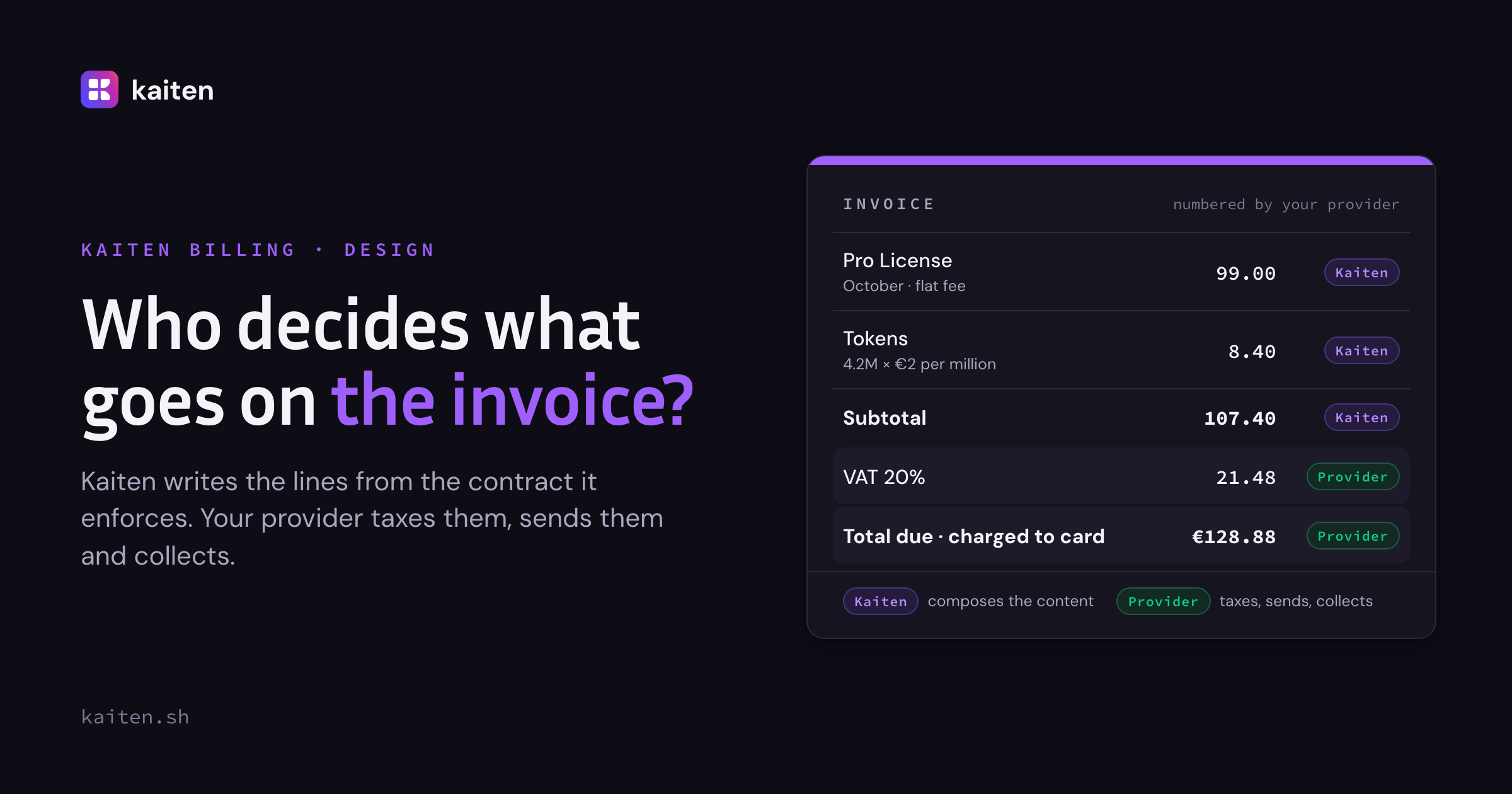
Who decides what goes on the invoice?
Most B2B SaaS count usage twice: once to enforce the contract, once to bill it. Kaiten Billing counts it once. Kaiten writes the invoice lines from the contract it already enforces; your billing provider taxes them, sends them and collects.
October 15, 2026 • 12 min read
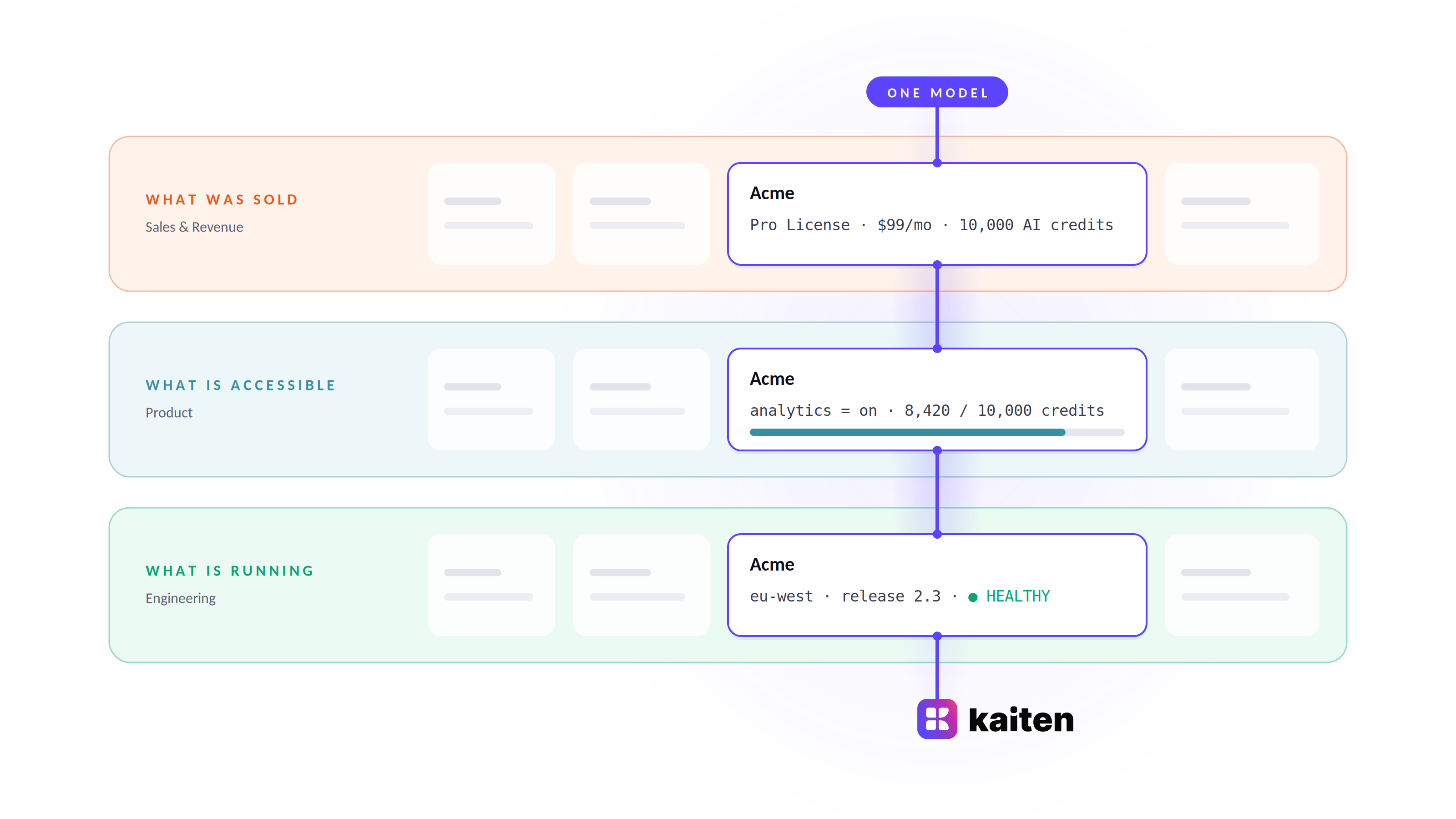
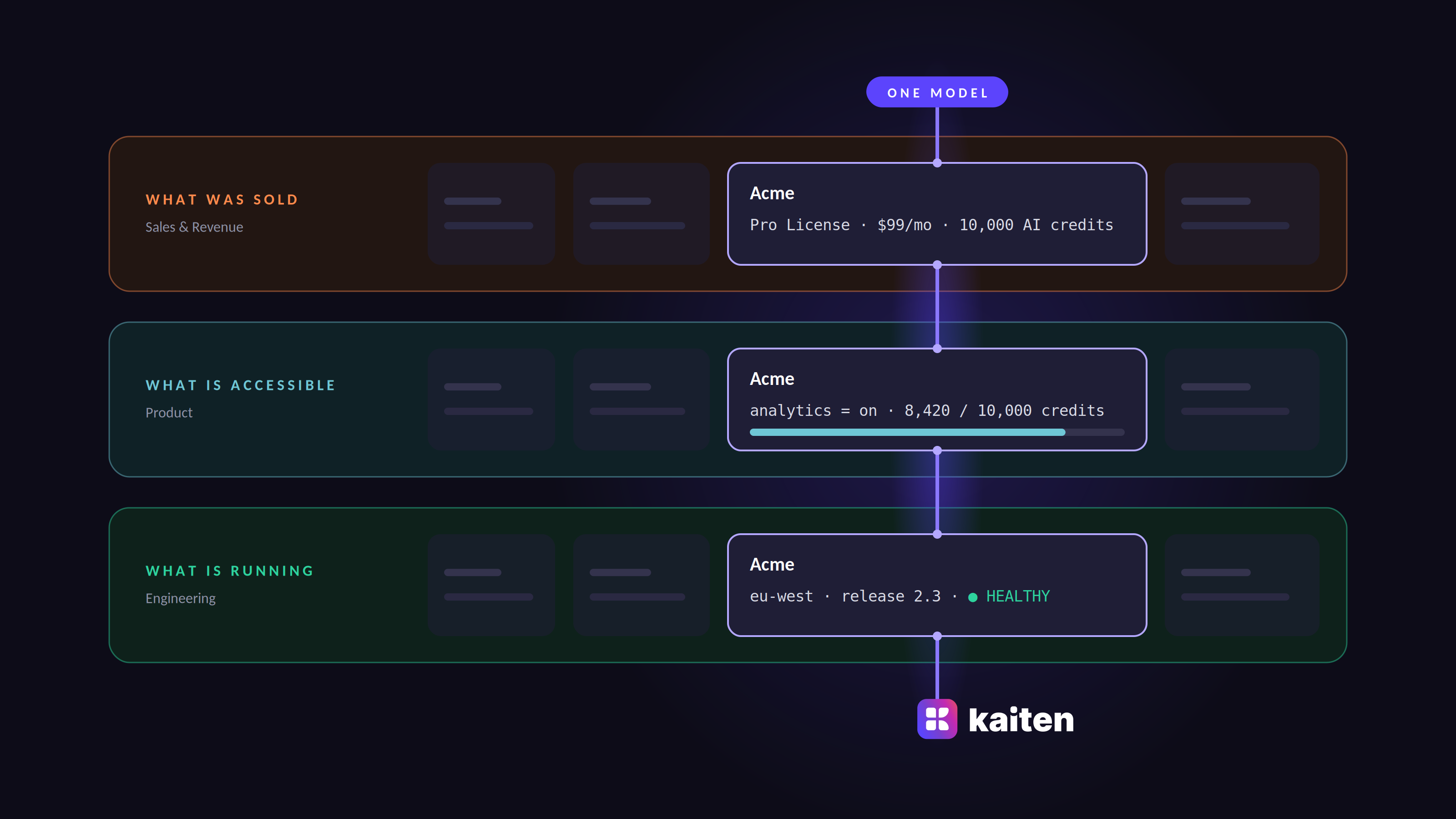
Kaiten: what we believe, and where we're going
Every B2B SaaS has a second product it never planned to build — the code that decides what the first one does for each customer. We are open-sourcing it.
October 5, 2026 • 20 min read
Kaiten is open source, under Apache 2.0
As of today, the whole Kaiten repository is public under the Apache 2.0 license, and so are our SDKs and our CLI. What's in it, why Apache 2.0, and what comes next.
October 1, 2026 • 5 min read